Best Spoken English Training in Trivandrum, Kerala
Best Spoken English Coaching in Trivandrum, Kerala
Speaking English fluently is no longer a herculean task as learning how to speak English has many an innovative measure. Camford Academy has devised frequently many advanced tips to deliver spoken English modules. Varous components of English are merged in the spoken english class at Camford Academy. Searching for the best spoken English coaching in Trivandrum, Kerala? Camford Academy has proved time and again the best Spoken English training centre in Trivandrum. Spoken English coaching in Trivandrum and the name Camford Academy have more or less become synonymous in Kerala, India. Even though there are many Spoken English training centres, Camford's Spoken English Class has a cutting edge over its competitors because its learning is blended with innovative language learning strategies widely employed by Cambridge University, UK. Camford Spoken English has become the most trusted synonym for Spoken English in Trivandrum.
Spoken English Training Class in Trivandrum
Spoken English learning in non-English speaking countries like India has almost become a buzzword among budding and aspiring talents. It has somewhat become a pillar of one's professional success. Thanks the advent of technological era. Hence, spoken English / communicative English is used as a platform for developing one's career. No doubt, the language of a person differentiates him from an animal. English is of paramount importance as it is useful in every walks of life. The language that one masters decides one's personality as well.
Factors affecting English language fluency
- A Many of the English language teachers in India are reluctant to change their teaching strategies, that is, they mainly follow the lecture method which has been proved fruitless by many studies across the countries.
- B While teaching English language, teachers are becoming active player eating away the major chunk of students' time. As a consequence, students are becoming passive ending up as mere spectators.
- C Teachers are using very little audio-visual and other teaching aids in a language class room.
- D Students / learners are given very little time to interact or to apply what they learn in a class. Possibly, teachers are ill-equipped to teach strenuous English language components breaking up it into easily digestible units.
Therefore, Camford Academy has been set up as remedial measure to the above mentioned problems. We undertake coaching Indian learners of spoken English by applying Cambridge University's widely practiced teaching methods. Camford Academy's spoken English / communicative English focusses not only on developing one's spoken English but on developing listening skill to native English accent, writing skill for business communication, etc..Also, our spoken English programme lays stress on speaking English fluently, accent nuetralization, mother tongue influence reduction .
Camford Spoken English Coaching
-
Different grammatical components
-
Accent Neutralization
-
Reduction of mother tongue influence
-
Most useful vocabulary for effective communication
-
Group Discussion
-
Stage Presentation
-
Attending Interview
-
Speaking English fluently
Spoken English in Trivandrum
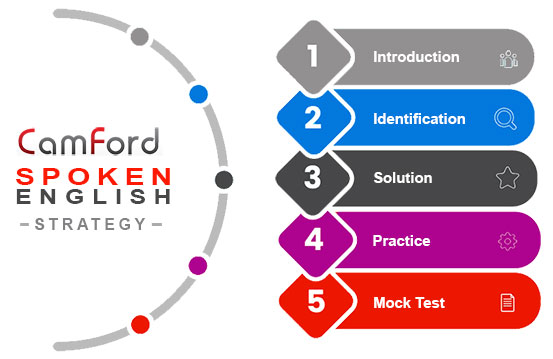
Camford Spoken English Strategies
- Join Camford Spoken English program.
- Weak areas in your English language are identified
- Solutions are suggested to improve your proficiency in English.
- We make sure that you get enough practice sessions and interaction.
- Weekly assessment on how much a student has improved.
- Extra work is given to fine tune your proficiency.
- Finally, you are prepared to face the competent and professional world.
- Spoken English Course Fees Two months Rs 8000/-
- Spoken English Course Fees One month Rs 5000/-
- Spoken English Course Fees Two week Rs 3500/-
- Spoken English Course One week Rs 2500/-
Class Timings
| Time | Monday | Tuesday | Wednsday | Thursday | Friday | Saturday | Sunday |
|
Morning Batch
07:00am - 09:00am
|
7:00am - 9:00am |
7:00am - 9:00am |
7:00am - 9:00am |
7:00am - 9:00am |
7:00am - 9:00am |
No Class |
No Class |
|
Regular Batch
10:00am - 01:30pm
|
10:00am - 01:30pm |
10:00am - 01:30pm |
10:00am - 01:30pm |
10:00am - 01:30pm |
10:00am - 01:30pm |
No Class |
No Class |
|
Afternoon Batch
2:00pm - 5:30pm
|
2:00pm – 5:30pm |
2:00pm – 5:30pm |
2:00pm – 5:30pm |
2:00pm – 5:30pm |
2:00pm – 5:30pm |
No Class |
No Class |
|
Evening Batch
5:30pm - 7:30pm
|
5:30pm - 7:30pm |
5:30pm - 7:30pm |
5:30pm - 7:30pm |
5:30pm - 7:30pm |
5:30pm - 7:30pm |
No Class |
No Class |
|
Weekend Batch
10:00am - 05:00pm
|
No Class |
No Class |
No Class |
No Class |
No Class |
10:00am – 5:00pm
|
10:00am – 5:00pm
|
what our students speak

A highly recommended destination for ielts preparation in Trivandrum. I have secured an overall score 8 (L8.5 R8 W7.5 S7). I sincerely express my gratitude to Mr.Netto , the man behind the scene and success in its entirety. Netto sir, as we fondly call him, is a very approachable and remarkably capable person in English training. He is conspicuously aware of the content, schemas and styles required to crack the examination. If you impress him, consider you have aced the exam. He has a unique capability in identifying the deficiencies in each of his students and train them accordingly. Dear friends, nothing comes easy in life, a little sweat and focus can paint colourful magic in the thin blue sky and Netto sir makes sure you do it. Thank you Camford and team (manager- Ms.Aarya), I dedicate this success to you guys.
Dr. Abishek Menon
A gave my ielts exam on 25th and my result is out. I am glad to receice the ielts score card with Writing 7 , Speaking 7,.Reading 7 & Listening 7.5. Its a result of strategies and methods from Camford Academy. Its a great experience learning with various strategies separately applicable for each listening, reading,writing and speaking. I have no words to express my gratitude to Mr.Netto sir who have put their immense effort in diving each candidate individual attention.
Nima Manu
My IELTS SCORE Listening -8, Reading - 7.5, Writing - 7 and Speaking - 7.5. This score is a kind of dream come true. I am very happy to be a part of Camford academy. The coaching and guidance I received from this institute was really effective. Many thanks to Netto sir for motivating and encouraging me to make my IELTS coaching really easy. The corrections and suggestions I received from sir were really helpful in achieving an excellent score of overall 7.5. Thank you sir specially for improving my writing skill. I wish all the very best to Camford academy.
Mrs.Ancy Jose
Useful links
For more information on IELTS Coaching in Trivandrum
For more information on IELTS Online Coaching in Kerala
For more information on IELTS Coaching in Kerala
For more information on Spoken English Coaching Class in Trivandrum Kerala
For more information on OET Coaching Class in Trivandrum Kerala
For more information on IELTS Speaking Tutorial
For more information on IELTS Thiruvalla
To read students' reviews on Camford IELTS Trivandrum
To watch IELTS Success videos of Camford IELTS Trivandrum
To read Camford IELTS Essays Task2 for IELTS Academic & General Modules
To read Camford IELTS Essays Task1 for IELTS Academic & General Modules
To learn Camford IELTS Vocabulary
For more information on OET Thiruvalla
For more information on Spoken English Thiruvalla